
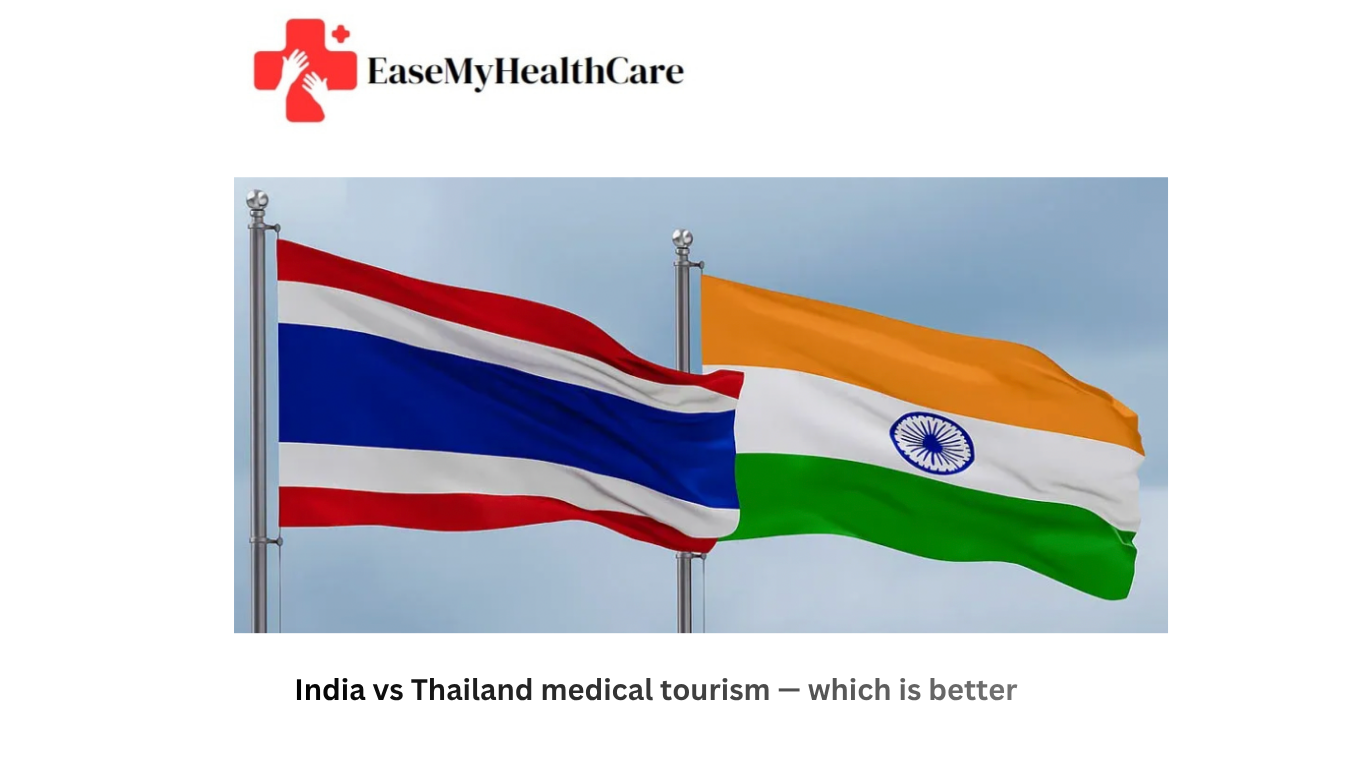
You’ve narrowed it down to two options. Both keep showing up in every “best medical tourism destinations” list you find. Both promise world-class hospitals, English-speaking doctors, and prices a fraction of what you’d pay at home. So which one actually deserves your trust — India or Thailand?
Here’s the honest answer: it depends on what you’re traveling for. India and Thailand aren’t really competing on the same turf. Each has built genuine strengths in different areas, and understanding those differences will save you more money and stress than any generic “top 10” list ever could. This guide breaks down exactly where each country wins, backed by real numbers.
On this page:
- Quick Answer: Which Country Wins?
- Cost Comparison
- Where India Wins
- Where Thailand Wins
- Hospital Accreditation Compared
- Leading Hospitals in Each Country
- Which Country Fits Your Situation
- Frequently Asked Questions
Quick Answer: Which Country Wins?
For cardiac surgery, organ transplants, orthopedic procedures, and cancer treatment, India generally wins on cost, surgical volume, and track record, with treatment often running 60–70% less than equivalent care in Thailand. For cosmetic surgery, gender-affirming procedures, and a wellness-focused recovery experience, Thailand generally wins, backed by decades of specialization and a more resort-style hospital environment. Since your ideal destination depends entirely on your specific treatment, share your case with EaseMyHealthcare for a direct comparison matched to your procedure.
Cost Comparison
| Procedure | India (USD) | Thailand (USD) |
|---|---|---|
| Heart bypass surgery (CABG) | $5,000 – $9,000 | $15,000 – $25,000 |
| Knee replacement | $3,500 – $8,500 | $12,000 – $18,000 |
| Kidney transplant | $7,000 – $13,000 | $20,000 – $35,000 |
| Dental implants (per tooth) | $400 – $900 | $1,000 – $1,800 |
| Cosmetic surgery (rhinoplasty) | $1,500 – $3,500 | $2,500 – $5,000 |
Figures are planning-range estimates and vary by hospital, technique, and case complexity.
Beyond the procedure itself, total trip cost matters too. For patients traveling from Africa and the Middle East specifically, flights to Indian hubs like Delhi, Mumbai, and Chennai are often notably cheaper and more direct than flights to Bangkok, which adds up quickly once you factor in the full journey.
Where India Wins
India built its medical tourism reputation on high-volume, high-complexity procedures, and the numbers back it up:
- Cardiac surgery: India has the longest track record globally in cardiac medical tourism, with surgeons who routinely perform hundreds of bypass procedures a year individually, driving both skill and lower cost.
- Organ transplants: India performs a significantly higher volume of kidney and liver transplants for international patients than Thailand, at a fraction of the price.
- Orthopedic surgery: Joint replacement costs in India run well below Thailand’s, without a meaningful gap in surgeon expertise or implant quality.
- Specialist density: Because of its sheer population scale, India has a higher concentration of specialist surgeons per capita, which translates into deep, procedure-specific experience.
- Overall cost savings: According to India’s Ministry of Tourism, international patients in India typically spend 60–70% less than they would for equivalent treatment in Thailand.
Where Thailand Wins
To give you the full picture, Thailand genuinely excels in areas India doesn’t prioritize as heavily:
- Cosmetic surgery: Thailand is widely considered Asia’s leader in elective cosmetic procedures, including breast augmentation, facelifts, and rhinoplasty, backed by extremely high surgeon case volumes in this specific specialty.
- Gender-affirming surgery: Thai surgeons have decades of specialized experience here, among the highest case volumes globally.
- Recovery experience: Thailand markets itself explicitly as a “medical vacation,” combining treatment with beach resorts, spa culture, and wellness retreats during recovery.
- Hospital hospitality: Thailand’s top hospitals are known for hotel-like environments, on-site cafes, and concierge-level service that feels more like a resort than a clinical facility.
- JCI accreditation count: Thailand has more JCI-accredited hospitals overall than India, roughly 60+ compared to India’s 40+.
Hospital Accreditation Compared
Both countries maintain strong accreditation standards, though the frameworks differ slightly. In India, hospitals pursue NABH accreditation as the national standard, with many leading hospitals also holding JCI accreditation for international credibility. Thailand relies primarily on JCI accreditation, with a larger overall count of accredited facilities concentrated in Bangkok, Phuket, and Chiang Mai. Importantly, a higher accreditation count doesn’t automatically mean better individual outcomes — what matters more is the specific hospital’s case volume and track record for your exact procedure, which is worth verifying independently in either country.
Leading Hospitals in Each Country
| Country | Hospital | Known For |
|---|---|---|
| India | Apollo Hospitals | Largest cardiac and multi-specialty network |
| India | Medanta – The Medicity | Robotic surgery, complex cardiac and transplant cases |
| India | Fortis Healthcare | Multi-specialty care with strong international patient support |
| Thailand | Bumrungrad International Hospital | Asia’s most internationally recognized hospital, extremely high patient volume |
| Thailand | Bangkok Hospital | Part of Thailand’s largest private healthcare network |
| Thailand | Samitivej Hospital | Strong in pediatrics and women’s health |
Every hospital in EaseMyHealthcare’s network is chosen specifically for procedure-specific case volume and verified accreditation.
Which Country Fits Your Situation
If you’re facing a cardiac procedure, organ transplant, orthopedic surgery, or cancer treatment, and cost plus surgical track record matter most to you, India is generally the stronger choice. If you’re considering elective cosmetic surgery, gender-affirming care, or want to combine treatment with a beach-resort recovery experience, Thailand is worth serious consideration. And if you’re simply unsure which category your treatment falls into, that’s exactly the kind of question a proper case review answers quickly, based on your actual diagnosis rather than a generic comparison.
Frequently Asked Questions
Is India or Thailand cheaper for medical treatment?
India is generally cheaper, with international patients typically spending 60–70% less than equivalent treatment in Thailand, according to India’s Ministry of Tourism.
Which country has better hospitals — India or Thailand?
Both have internationally accredited hospitals. Thailand has a higher overall count of JCI-accredited facilities, while India has a higher concentration of high-volume specialists, particularly in cardiac, transplant, and orthopedic care.
Is Thailand better for cosmetic surgery than India?
Thailand is widely regarded as Asia’s leader in elective cosmetic surgery, with surgeons who have among the highest global case volumes in procedures like rhinoplasty, breast augmentation, and body contouring.
Which country is better for cardiac surgery?
India, with the longest track record globally in cardiac medical tourism and significantly lower costs, while maintaining success rates comparable to leading Western hospitals.
Is the language barrier a problem in either country?
Doctors at top-tier hospitals in both India and Thailand are fluent in English. India additionally offers Arabic and French interpreter services at many hospitals catering to Gulf and francophone patients specifically.
Do I need a different visa for India versus Thailand?
Yes, each country has its own medical visa process. India issues a dedicated Medical Visa (MED-X) with an attendant visa option, while Thailand has its own separate medical visa category with different documentation requirements.
Get a Personalized Comparison for Your Case
The right destination depends on your specific procedure, not a generic country ranking. Share your case for a free, honest comparison and treatment plan matched to what you actually need.